

Transforming Retail Churn with Predictive Analytics

Retailers operate in a highly competitive environment. Moreover, technology allows information-savvy consumers to access details of products and best prices at their fingertips. The lower switching cost also makes the customers transient. This very nature of the customers leads to a common phenomenon described as customer ‘churn’ or ‘defection’. This refers to a customer who ceases his/her relationship with the firm. Churn is experienced across industries and the churn rates vary across sectors. Factors causing customer churn can be attributed to poor customer service, insufficient inventory or unsatisfactory shopping experience. The definition of churn may vary depending upon the platform and location of the store. The average churn rates may range from -10% to 60% per annum. And, for a retailer, these figures could vary anywhere between 10% — 30% per annum.
Companies can’t afford to lose hard-won customers. However, burning cash to build consumer loyalty can cost firms their fortunes. So, it is necessary to understand that not every customer relationship is equal and neither it should be treated equally. Some customers are worth more than others. Our predictive model is built on this foundation.
The Problem
A leading Delhi based retailer was experiencing issues related to customer loyalty. Despite their long-running loyalty programme, the churn rates were significantly higher compared to industry benchmarks. Also, their persistent efforts to retain customers helped them temporarily.
We seized this opportunity to present a solution which uses customer transactions to predict future churners with the help advanced Machine learning algorithms. Beyond predictions, the model also identifies churners eligible for the retention campaign. This optimizes the target group size and thus the campaign budget.
Solution Approach
Our approach is executed in two phases. As discussed above, the first phase focuses on predicting the potential churners for the next three months. On the other hand, the second phase determines the optimum size of target group for the retention campaign.
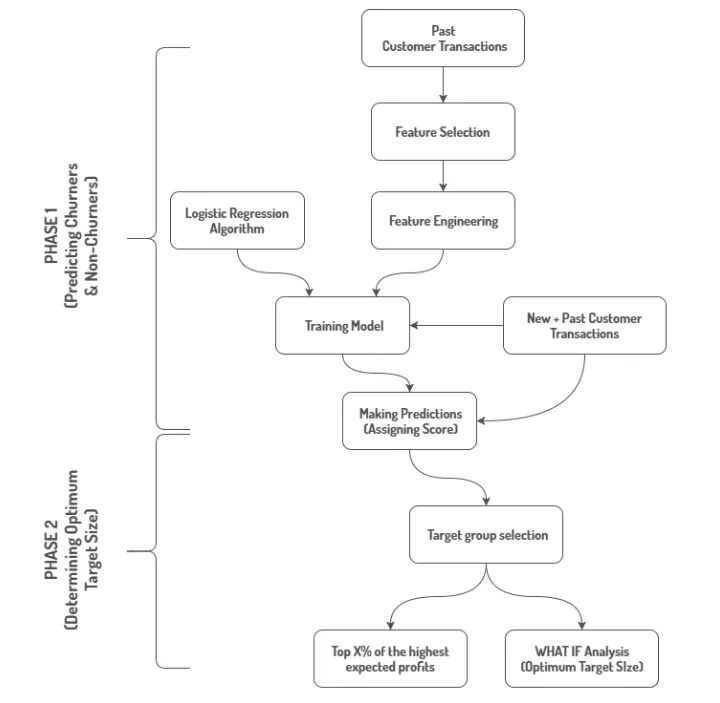
To predict potential churners, we analyzed about a million transactions and retailer’s activity information like special events, promotions, etc. for a single store. Several iterations were carried on different machine learning algorithms. The ‘two class logistic regression’ produced best outputs. The core of algorithm uses sigmoid function. It assigns each customer with a score and classifies them as Churner or Non-Churner.
In the second phase, we took the assigned scores of individual customers and calculated the expected profit generated as a result of retention campaign. The probability that a customer will accept the offer was also included as a parameter. The underlying assumption being that the likelihood of acceptance would go up as the cost of retention action increases. The customers are ranked based on expected profits. Then, the top x% customers (decided by the management) are included in the target group. This target group is then exposed to the retention campaign.
Alternatively, the model can also provide an optimum size of target group. This is based on the campaign budget. The management can run a WHAT-IF analysis to determine the appropriate size of target audience. Again, the model uses expected profits to identify individual customers.
This model can be progressively trained to incorporate the latest data. This is expected to impart better prediction capabilities to the model and in turn good accuracy.
Results
The resulting model successfully predicted the likelihood of churning individuals with 97% accuracy (ratio of individuals correctly identified — churners and non-churners, to total number of individuals observed) and 68% precision (ratio of correctly identified churners).
Basing our analysis solely on customer transactional activity prevented any biases from extraneous factors to compromise with the performance of the model and quality of results.
Technology We used best-in-class open source technologies for creation and execution of this model. Our solution is not only fast and easily deployable, but also almost infinitely scalable. This capability is derived from Azure Machine Learning platform.