

Streamlining Health Insurance Claims Processing : Tariff Digitization and Standardization

AI-driven Intelligent Document Processing (IDP) in Health Insurance
*This article is authored by Sampurn Rattan (Lead Data Scientist) working at the Lumiq AIML Research Team.
TL;DR: The story of health claims is the story of documents. Processing the massive variety of documents accounts for a massive chunk of the time in a high-volume, time-critical process with some of the lowest turn-around-times in the Insurance Industry. Using an AI-based IDP platform, transform the tedious process into a digitized, automated one - transforming the way medical claims processing is approached today.*
The Fair Play in Indian Health Insurance report discovered in 2018, that India has the highest complaints rate when compared with other countries in Health Insurance. Most industry experts have summarized the issue to the document-heavy processes in the Health Insurance industry in India. Even the simplest of medical claims have at least 40 documents that require to be parsed, and some complex cases have up to 200 documents! To tackle these problems, insurers are now looking at AI/ML solutions.
In this blog series, we look at how an Intelligent Document Processing platform like Drishti Document AI can help at various steps of the entire health claim process.
What is a Medical Claim, after all?
There are three parties involved in any medical claim: the patient, the hospital, and the insurance provider.
In simple terms, a medical claim is a bill that hospitals and other healthcare providers submit to a patient’s insurance provider on behalf of the patient for a cashless visit. For a reimbursement-based approach, the patient, instead, directly interacts with the insurance provider after the treatment has been completed and requests a cash reimbursement equivalent to the treatment expense. Almost all medical claims require proof of diagnosis, treatment, and expense.
The AS-IS Process for a Medical Claim
Let us see the process flow of a hypothetical in-patient cashless claim.
In the traditional process, the first step is to get a patient check-up done. A doctor prescribes a treatment plan. For a cashless claim, the wheels are set in motion in the background whilst the treatment is ongoing (or about to start). The hospital TPA (Third Party Administrator) desk, a support system that serves as an intermediary for the hospital and the insurer, initiates the claim and fills most of the claim pre-authorization form for the patient — with the obvious exception of the patient’s PII details. In India, if the hospital expenses exceed INR 2 lakhs, then the patient must submit his/her AADHAAR card, otherwise, a simple PAN card would suffice as his/her identification card. In the claim form, the TPA desk inputs a rough estimate of the cost the ensuing treatment might outlay using the hospital’s tariff card (rate list, charge list, schedule of charges, memoranda of understanding, etc.). To support their estimate, they may add the doctor's prescription, medical tests that are done to confirm the diagnosis, and any medical invoices for already purchased medicines and physical treatments.
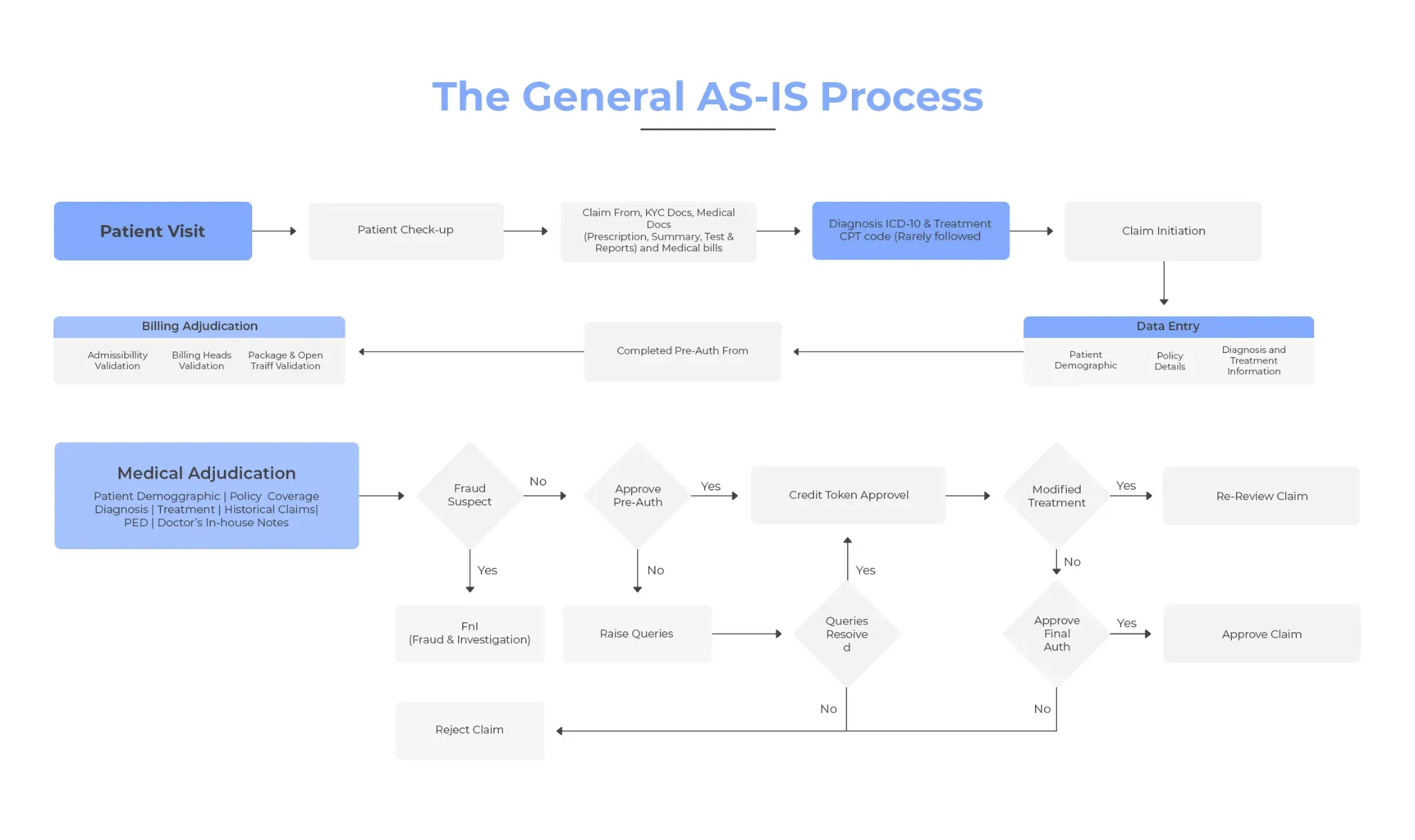
Now that the pre-auth claim form is complete, it is sent to the insurer for Billing Adjudication or sometimes called Benefit Determination. This is the first interaction with the insurer. As the name suggests, an adjudicator goes through the policy document of the patient, the tariff card, and other financial documents to validate the following:
- Whether the amount charged in the medical invoices is equal to the amount prescribed in the tariff card for each line item.
- Whether the policy purchased by the patient covers the treatments or not.
- Whether the treating hospital and doctors are in-network or not.
After, and if, billing adjudication is cleared, then a process called Medical Adjudication is invoked. In this, the diagnosis, the treatment, and their validity are reviewed by medical experts within the insurer’s organization. Each medical test, each medicine, each doctor visit is reviewed for its necessity. If the medical adjudicator finds any issue in the entire treatment plan, s/he can raise a query. Failing to answer which, the patient’s claim can be rejected. After medical adjudication is cleared, a credit token is approved as proof of clearing the pre-auth process.
The entire above-listed process is repeated for the final auth. Discharge summary and claim final authorization form need to be submitted additionally.
There are many more complexities and divergences in the flow as shown in Figure.
*Just writing this entire process felt tedious and cumbersome, we wonder how people can bear going through the actual process every time they visit a hospital!
Whew!*
The story of health claims is the story of documents
Just with a simple analysis of the traditional process, one can see multiple single points of failures and bottlenecks. We found the following common challenges across multiple insurers we surveyed:
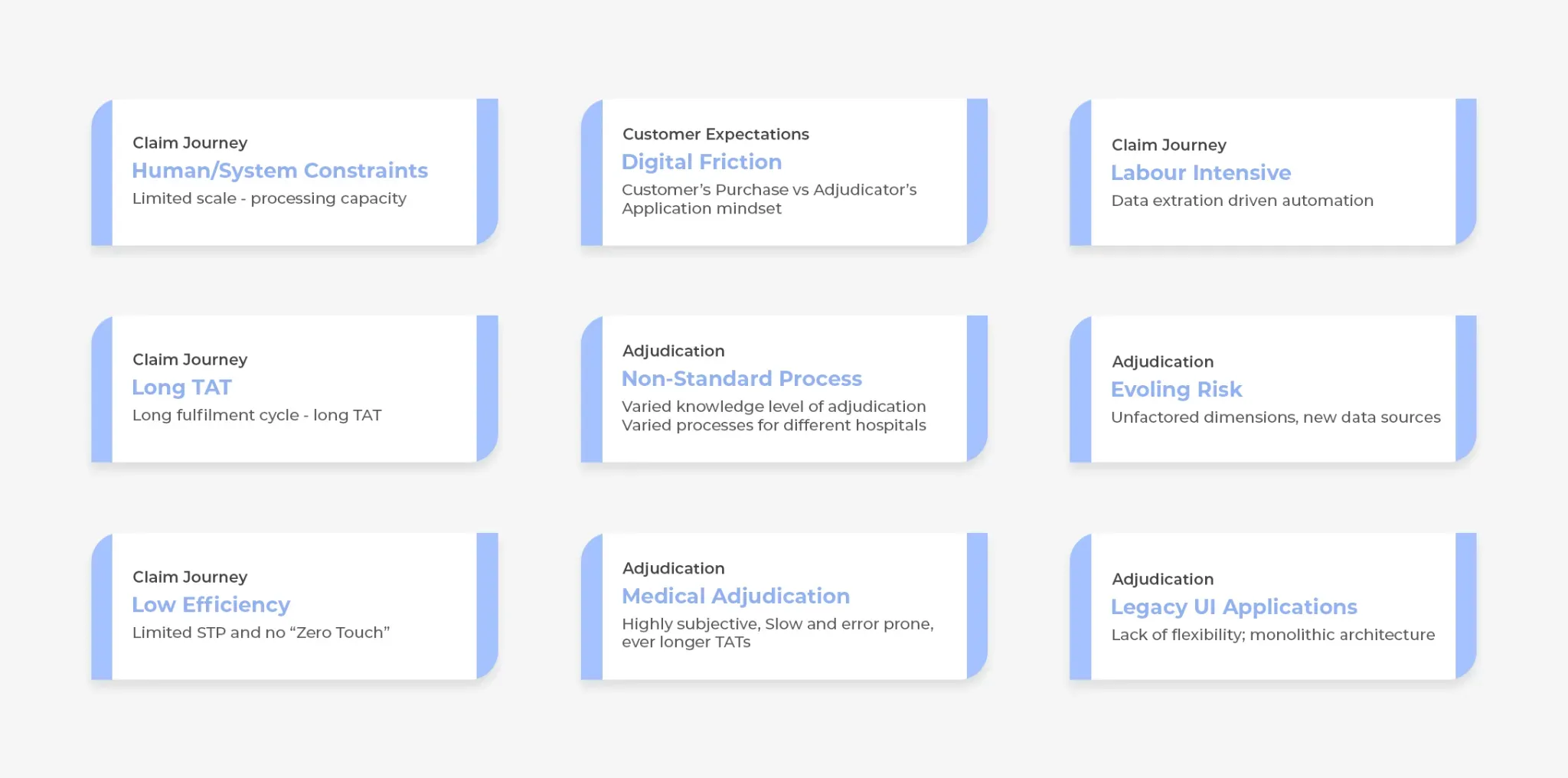
However, the biggest and the most common challenge we saw was the sheer volume of documents and their diversity at every single step of the process. In somewhat chronological order, we saw that the following documents are generally needed for every claim that is processed:
- Tariff card between the hospital and the insurer.
- Policy document between the patient and the insurer
- Doctor prescription provided by the doctor to the patient
- Claim forms (pre-auth and final) filled by the TPA and the patient submitted to the insurer
- Identification card provided by the patient to cross-check the names on various other documents
- Medical lab reports during the entire treatment
- Hospital and pharmacy bills (or medical invoices)
- Discharge Summary
What does the Ideal Medical Claims Workflow look like?
It is abundantly clear that if we can automate the extraction, standardization, and handling, in general, of these documents can solve many of the problems that exist in the current process flow.
But, solving this puzzle was not that simple. Each of these documents presented its own unique challenges:
- The tariff card is so unstructured that no two documents are of the same format ever. It is a massive document — usually more than a hundred pages from which each line item needs to be extracted and standardized. This was such a complex, challenging and fun problem that we dedicated an entire blog (Part 2) talking about it.
- The policy document although has a static template, however, it contains a lot of information that needs to be extracted, as well. The doctor's prescription is unorganized with barely legible handwriting, and sometimes even symbols. Claim forms, again, are handwritten with a massive scope for error. There are 250+ variations of valid identification cards in India! Each pathology lab has its own format and terminology for each medical report. Every invoice looks the same but is ever so (troublingly) different. The discharge summary is a massive document with pockets of information separated by pages that is relevant to the medical adjudicator. We discuss how to take up these problems in the next part (Part 3).
So, what does the end-to-end automated medical claims workflow look like?
The one envisioned by us looks something like this:
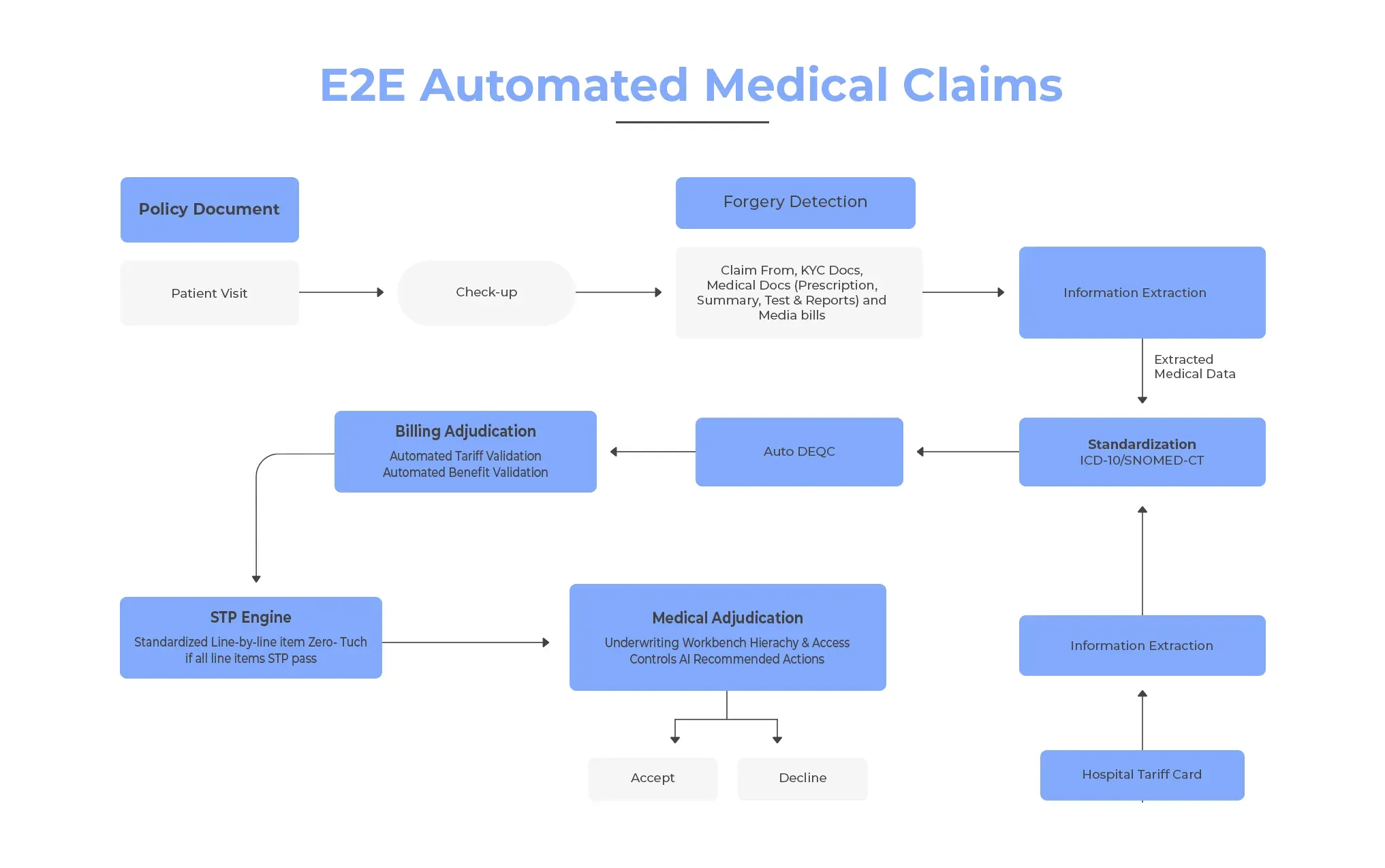
In the next part of this blog series, we detail the IDP-related part of this ideal solution.
To know more about Lumiq’s intelligent document processing capabilities, visit us at https://lumiq.ai/drishti/
We also used Drishti to automate customer onboarding for one of the biggest insurers in India, to know how we achieved it, also read Automating customer onboarding with Lumiq Drishti.
For even more information, ping us at [email protected]