

Revolutionizing Data Lakes with Amazon S3 Tables
The Challenge
Traditional data lakes are powerful but plagued by issues such as:
- Inefficient Query Performance: Small file accumulation leads to performance bottlenecks.
- Complex Maintenance: Manual tasks like file compaction and snapshot management are time-consuming.
- Access and Security: Implementing granular access control is difficult in expansive data lakes.
The Solution: Amazon S3 Tables
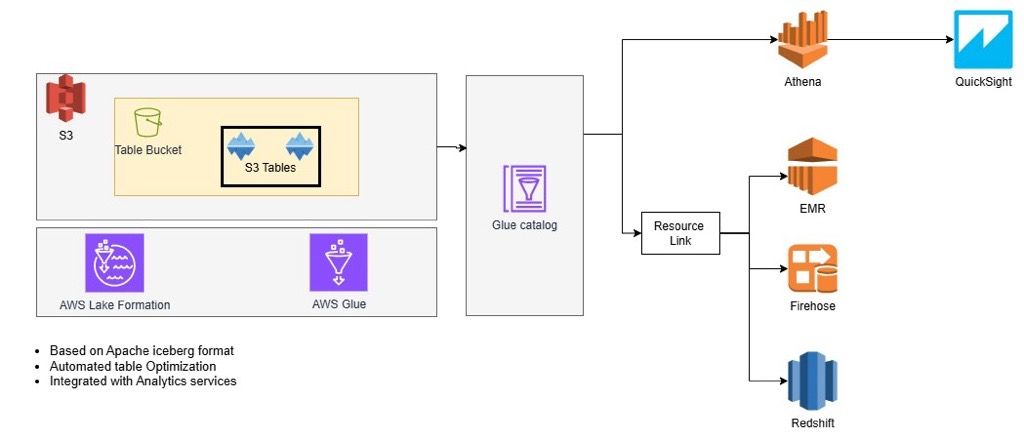
Amazon S3 Tables, built on the Apache Iceberg format, address these challenges by:
- Automating data lake maintenance with built-in compaction and snapshot lifecycle management.
- Ensuring ACID compliance for transactional data.
- Optimizing query performance through advanced file handling and partitioning.
- Offering seamless integration with AWS services like Athena, Redshift, and Glue.
- Providing fine-grained access control using IAM.
Added Insights for Enterprise Use
- Cost Management: Archive infrequently accessed data to S3 Glacier while retaining recent data in S3 Tables.
- Real-Time Analytics: Pair Iceberg tables with streaming data sources like Kinesis/Kafka for dynamic dashboards.
- Scalability: Handle diverse datasets like IoT telemetry or customer interaction data with ease.
The Impact
By adopting Amazon S3 Tables, enterprises can:
- Simplify operations with automation.
- Enhance analytics performance with optimized storage.
- Scale effortlessly with S3’s robust infrastructure.
Ready to Transform?
Start building your managed transactional data lake today with Amazon S3 Tables. For advanced strategies and use cases, explore the official documentation.