

Prompt-Based Development: The Current Landscape and Path to Full Autonomy

In a previous blog, we explored a transformative idea: shifting from traditional coding instructions to coding intent through prompts. This evolution is not just theoretical—many foundational pieces already exist.
In this follow-up, we analyze the current state of prompt-based front-end development, assessing the maturity of available tools and technologies, and mapping out the road ahead toward full autonomy.
Current State: What’s Available Today?
Prompt-based development relies on three key pillars:
- Prompt Engineering and Management (versioning, collaboration, and governance)
- AI-Driven Front-End Generation (code/design generation from prompts)
- Automated Testing and Validation (AI-driven test generation)
Here's the current landscape and maturity level for each:
1. Prompt Engineering & Management Tools
- Prompt Engineering & Management Tools
Prompt management involves versioning prompts like traditional code and maintaining them in Git-like systems.
- Langfuse: Offers prompt versioning, collaboration, analytics, and monitoring capabilities. Highly mature for prompt lifecycle management but primarily used for general AI applications rather than specific UI generation.
∘ Maturity:🔵 Medium-High
- PromptLayer / PromptHub: Tools to version prompts, track changes, and enable collaboration. These tools are robust but are still evolving in integration with CI/CD workflows and front-end use cases.
∘ Maturity:🟢 Medium
2. AI-Driven Front-End Generation Tools
- AI-Driven Front-End Generation Tools
These tools automatically generate front-end UI code or designs directly from text prompts:
- Vercel v0 (beta): Generates high-quality React and Tailwind CSS code directly from natural language prompts. The output is immediately usable, though limited to React/Next.js ecosystems.
∘ Maturity:🟢 Medium (rapidly improving)
- Webcrumbs Frontend AI (open-source): Supports generating code snippets in React, Vue, Svelte, and HTML/CSS from prompts. Ideal for rapid prototyping, but output often requires manual refinement.
∘ Maturity:🟡 Early-Medium
- Debuild: Transforms prompts into React components and backend queries. Great for quick MVP development, though often needs manual intervention for production-level quality.
∘ Maturity:🟡 Early-Medium
- Galileo AI / Uizard / Visily: Generate high-fidelity UI designs from text prompts, mainly useful for prototyping and early design stages. These tools are mature design-wise but do not directly produce deployable code.
∘ Maturity:🔵 Medium-High (Design Prototyping only)
3. AI-Driven Automated Testing Tools
- AI-Driven Automated Testing Tools
This crucial area is currently the least mature, but essential for true autonomy:
- GitHub Copilot: Primarily used for code assistance, it can help write tests but is not yet capable of reliably generating comprehensive, high-coverage tests autonomously.
∘ Maturity:🟡 Early-Medium
- TestGPT / CodiumAI: AI-powered tools emerging specifically to generate automated tests from code or descriptions. Early-stage, limited use in production-grade testing.
∘ Maturity:🟠 Early stage
Maturity Summary:
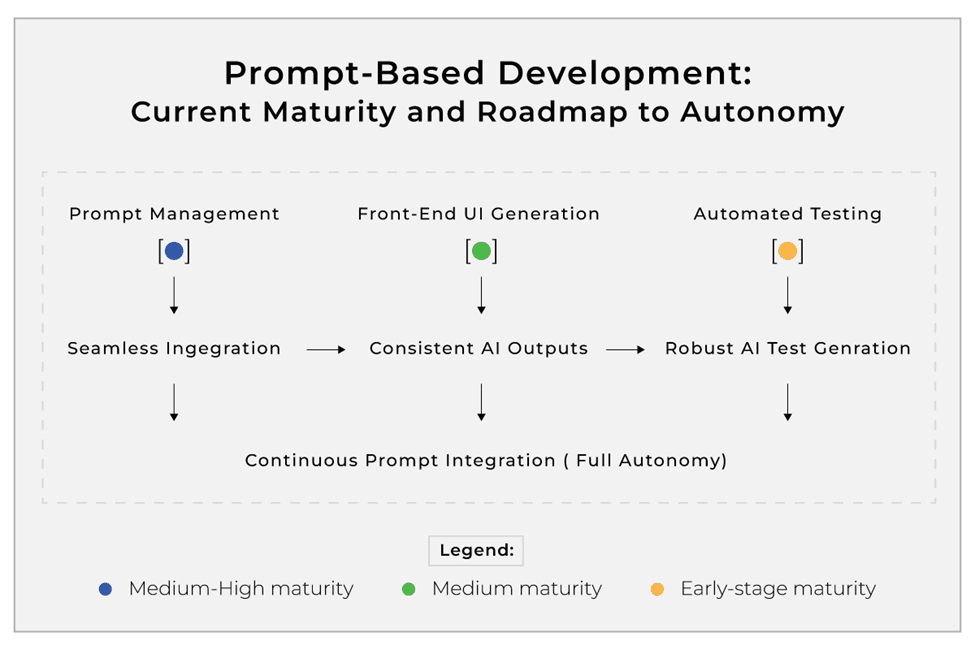
Following is the summary of the overall maturity as of now and as we know it is rapidly evolving
- Prompt Management:🔵 Medium-high maturity; tools are ready for integration into development lifecycles.
- Front-End UI Generation:🟢 Medium maturity; tools exist but vary widely in output quality and reliability.
- Automated Testing & Validation:🟠 Low maturity; the greatest current limitation to achieving full autonomy.
Challenges to Full Autonomy
While the foundational tools exist, several key gaps remain:
- Reliability & Consistency: Current AI-generated code varies significantly in quality and structure. Prompt adjustments often still require manual iterations.
- Testing Gap: Autonomous, comprehensive test generation is still underdeveloped. Without robust automated tests, AI-generated code can’t reliably move directly into production.
- Scalability & Maintainability: AI-generated code today often requires human intervention for refinement and long-term maintainability.
The Road Ahead: How Do We Reach Full Autonomy?
Here’s the anticipated roadmap:
Stage 1: Enhanced Prompt Governance – next few months
- Mature prompt management tools (like Langfuse, PromptLayer) gain deeper integrations into Git workflows and CI/CD pipelines, enabling seamless versioning and collaboration on prompts.
Stage 2: Improved AI Front-End Generation – rapidly evolving this year
- Tools like Vercel v0 and Webcrumbs significantly enhance their capabilities, offering highly consistent and production-ready outputs.
- Wider adoption drives specialized fine-tuning of AI models, further increasing reliability.
Stage 3: Reliable Automated Testing (< 2 Years)
- New generation AI testing tools (TestGPT, CodiumAI) mature, providing fully automated test coverage directly from prompts.
- Test-driven, intent-based prompt management becomes viable, significantly reducing manual validation requirements.
Stage 4: Full Autonomy & Continuous Prompt Integration (<2 Years)
- AI generation of fully-tested, deployable code from prompts becomes reliable enough to trust without human verification.
- CI/CD workflows become fully prompt-based—developers solely refine prompts, and AI handles the rest.
Final Thoughts: Embracing the Inevitable
Prompt-based development is not just possible; it’s already happening, albeit incrementally. The tools today, while promising, still require human oversight. The industry, however, is moving quickly toward maturity.
This evolution is inevitable and aligns logically with the historical shift towards abstraction in software development. Organizations that start experimenting today will have a significant advantage in embracing and influencing this next stage of technological maturity.
Prompt-based development is coming—Are you ready to shape the future?