

Data Democratization: Turning Knowledge into Business Dictionary
Knowledge Base: Making tribal knowledge accessible
This brings us to tribal organizational data. This is data which like tribal knowledge isn’t accessible to everyone. It is an intangible asset which can unlock competitive edge
When it comes to data, there are tons of insights that could be relevant to all your teams. But only the data folk know how to access it. Anyone who does not approach the data team and ask a very specific question, might not actually stumble upon useful insights over and above the ones that the data professionals dig out and present as insights.
One way to make tribal knowledge more accessible is to create a knowledge base that is accessible to all employees. This knowledge base could contain information on how to perform specific tasks, best practices, and other helpful resources. Additionally, this could also include videos, tutorials, and webinars that employees can access to learn more about the organization’s processes and procedures. The knowledge base should be regularly updated with new content to ensure that employees have access to the most up-to-date information.
After we set up a knowledge base, transforming ‘tribal organizational data’ into a business dictionary is the next step. This includes making raw organizational data accessible to different teams, with a keymap for articulating and navigating the data sources.
Step 1: Create a data catalog for decisioning
All departmental heads and managers (basically anyone who has to make decisions on behalf of the company) should have at least some level of data access. A good way to make this happen is to make a list or table or chart with headers and descriptions visible to everyone, so that the relevant team can make a request for the data that they need.
This is what you might call a data catalog. To make your data catalog truly effective, it should be searchable. Invest in Google-level searchability and add features like filters. Ensure that each of the items on the list comes with a short description or profile.
There are two types of data catalogs:
- Enterprise software data catalogs that are ready-made and ready to deploy
- Open source data catalog tools that are tailor-made for companies that want to create their own catalogs that they will open source to other parties.
Whichever option you find suitable, do get a proof of concept before accepting a solution.
Also set up evaluation criteria before you hit the market. Here’s one must-have for your checklist: When choosing a data catalog, look for the more advanced kind that doesn’t just store data, but also funnels it back into everyday workflows.
Step 2: Get started on a dictionary
In life, when we’re not sure of a word’s meaning, we can quickly Google it, and we’re one word wiser in seconds. Data terms are a lot harder to wrap one’s head around. You need to find a way to bridge the language gap between your data folks and the rest of the organization. One way to do that is to develop a glossary of data terminology to help the whole team at least understand — if not speak — the language of data.
Every time someone doesn’t know a data term, they should flag it up, and it can be added to the dictionary. Incentivize data folks to contribute to the data terms glossary with little things like meal or shopping vouchers.
Step 3: Strike a balance between governance and democratization
You want everyone to be able to get insights. But you also want to maintain a balance between governance and democratization. Your data is precious; your customer data might be sensitive. You don’t want to land yourself in a legal soup or leave your secrets out in the open.
That’s why we talked about having an open-to-everyone index of data insights, but to actually access the insights, the user should have to send a request. Depending on how sensitive your data is and what kind of work you do, you could have tiered access for various job titles, roles, or departments.
Step 4: Enable data virtualization
Data virtualization eliminates challenges like differing formats linked to different sources and so on. It allows a non-data-professional to see data from multiple sources and formats without having to get into the technicalities of it.
Step 5: Tap into the power of visuals
Flowcharts, pie charts, bar charts, line charts, UML diagrams — any visual representation of data can simplify data and make it easy to spot insights.
Step 6: Include no-code data exploration tools
With the coding barrier eliminated, you open up your data to non-data-professionals. With this move, lay people can ask questions and get answers from the data. They won’t need the ordained data lot for every little insight. Look for easy-to-use data exploration tools. Involve non-data-professionals in vendor discussions and demos to evaluate if they will really find data exploration tools easy to use.
Step 7: Host advanced data training (for all departments)
At a basic level, you want to develop the ability to read and analyze data, and to question it to a reasonable extent. You want all your organization’s decision makers to be confident when asking your data folks for insights, and when they finally make decisions based on the insights.
If a team wants a set of predictive analytical insights, they should know what to ask for. Or if a financial model is required, the team should know how to outline requirements. The same goes for product roadmapping and development — it’s easier with data, but the hands-on team and the data team need to speak a language that both understand. That should be the main goal of your data training.
At a more advanced level, teams should be able to create their own dashboards and draw insights independently.
Step 8: Foster a data-first culture
Most departments are going to rely on data and as such, you need everyone on the team to be on board with the fact that data literacy is a priority. If your KPIs are better met with data, you need to be a data expert to a reasonable degree — get your team aligned with this fact.
If you’re doing step 6, then everyone should become comfortable with key data terms and should be confident talking about data. One way that you might achieve this, is to rope everyone into making contributions and suggestions to data projects linked to their area of work.
Of course, data needs to be sourced somewhere, and that means that you need to make documentation a part of your organizational culture. Urge people to document processes and alternative processes, workflows, hacks, feedback, findings, timelines, and anything that amounts to internal or external intelligence. Even processes (or customer initiatives or product developments) that failed should be documented, along with any information on why they failed. This is how you move from a tribal data culture to a data-first culture. Documentation is key.
Sounds like a lot of extra work? Enter automation.
Step 9: Activate data automation
As far as possible, you want data to be extracted from various sources, transferred into required formats, loaded into data warehouses and juiced into insights automatically rather than manually.
Your teams are busy and if being data-first means increased admin load, you’re going to get a lot of pushback. Make it easy for everyone in the organization to document data points and extract insights. Luckily, tech has your back.
To sum up
Your data can boost productivity, performance, and profitability across your organization. Data already exists; you simply need to harness its power and give more people access to its power, to make it a driving force for better business success. It’s easy to democratize data with the right tools and the right partner.
Connect with usto learn how we help modern financial enterprises democratize data, leverage it, and drive profitability.
Tribal knowledge: Any unwritten information that is not commonly known by others within a company. This term is used most when referencing information that may need to be known by others in order to offer products or services.
Tribal knowledge isn’t formally documented and might be held by top management, domain experts, or industry veterans. It might also be known exclusively to the data tribe within the organization.
Most leaders agree that the old style of relying on tribal knowledge can hinder speedy growth and digital transformation in modern businesses.
Enterprises are operating in a competitive and unpredictable (veering quickly towards gloomy) post-pandemic world. This means that all your teams need access to insights that can help them optimize processes, productivity, and profitability. If any data can help your teams overcome business challenges and fast-track business goals, they deserve access to that data.
But, it is not as smooth as it should be.
You require a central, accessible organization-wide data repository. Sounds good on paper. But there’s a language barrier. Not everyone speaks data. Data professionals speak the language of data fluently, but to make data more accessible, companies need to make it possible for non data professionals to understand data to a level that they can derive use from it.
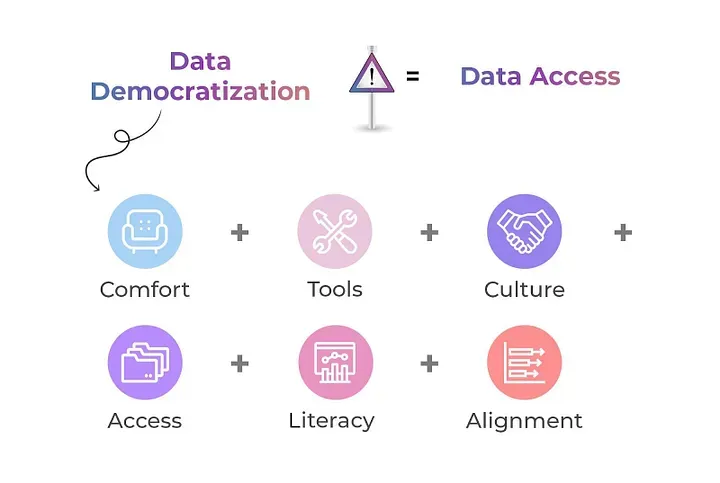
That’s where data democratization comes into the picture.
You not only centralize data from all its silos, but also make it understandable. You set it up in such a way that non-data-professionals can also extract the insights that they need from it.
So, the transformation of tribal knowledge becomes evident to achieve a result-driven democratization of data.