

Data Audits for IPOs, Mergers: How FSIs Prepare for Changes
n the Financial Services and Insurance (FSI) space, mergers and consolidations are commonplace where two or more symbiotic brands consolidate or merge. So are IPOs. In this post-modern banking era, these activities — IPOs, M&As — have evolved to rely more heavily — and more strategically — on data reliability and audit management.
Growing volume of IPOs
Let’s talk about IPOs. The process of an initial public offering on any stock exchange requires a slew of entity data to be subject to scrutiny, and any slight issue with entity management and paperwork could derail the whole effort. PwC, one of the Big 4 accounting firms and IPO experts, suggests a one- to two-year period is needed to plan and build the capabilities to think, act and perform as a public company. For robust data management solutions to aid in this process, explore Pryzm by LUMIQ.
Data Mismanagement can derail and offset proceedings
Data mismanagement is one of the challenges to creating synergies post-mergers and acquisitions. Data storage forms can be completely different and incompatible; two companies might capture and manage data differently, and varying standards, formats, quality, and relevance can prove to be an obstacle.
For companies with an IPO or M&A on the horizon need to start looking at data as a crucial strength (but also as a potential weakness). In other words, data left mismanaged can present a threat, but if managed well, can present a massive opportunity. Tools like Agency Workplace and Customer Advisory can assist in ensuring that data is managed correctly and efficiently.
It is widely recognized that the wrong data in the wrong hands can create PR, legal and compliance problems for companies. However, strategically placed data can serve to underscore the company’s clean slate. Additionally, the right data can give the IPO-bound company the very desirable “nothing to hide; nothing to fix” appearance that is invaluable when the company is under immense scrutiny — by the public, by institutional investors, and by SEBI — in the run-up to getting listed.
Some BFSI companies might consider guarding their data with an iron fist, but the truth is that investors will expect a certain level of transparency and visibility, and a lack of these traits might affect how potential investors judge the company.
Data Mismanagement can derail and offset proceedings
Data mismanagement is one of the challenges to creating synergies post-mergers and acquisitions. Data storage forms can be completely different and incompatible; two companies might capture and manage data differently, and varying standards, formats,quality ,and relevance can prove to be an obstacle.
For companies with an IPO or M&A on the horizon need to start looking at data as a crucial strength (but also as a potential weakness). In other words, data left mismanaged can present a threat, but if managed well, can present a massive opportunity.
It is widely recognised that the wrong data in the wrong hands can create PR, legal and compliance problems for companies. However, strategically placed data can serve to underscore the company’s clean slate. Additionally, the right data can give the IPO-bound company the very desirable “nothing to hide; nothing to fix” appearance that is invaluable when the company is under immense scrutiny — by the public, by institutional investors, and by SEBI — in the run-up to getting listed.
Some BFSI companies might consider guarding their data with an iron fist, but the truth is that investors will expect a certain level of transparency and visibility, and a lack of these traits might affect how potential investors judge the company.
6 Steps to Data Audit Management
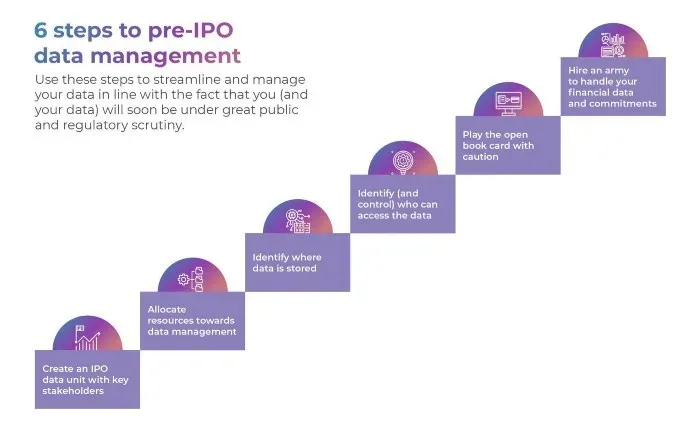
Here are 6 steps that Data Audit-bound companies cannot afford to miss as they prepare to go public:
1. Create an IPO/ M&A data unit — Strike Team — with key stakeholders
Your IPO Data Management strike team should include heads — or key individuals with a sufficient overview — of security, privacy, and processes. The team should also include compliance and the legal department.
The Data Management Strike team will ideally be tasked with conducting a data audit and then setting up processes and standards for data management. This is just the beginning. A company’s data will continue to be a matter of public interest for as long as it is publicly listed.
2. Allocate resources towards data management
Audits are a stressful period for BFSI companies because their data and processes are viewed under a microscope. When you go public, that level of scrutiny becomes an everyday feature. Expect and prepare for in-depth scrutiny of financial statements, budgets, revenue, and projections.
The best way to achieve improved data management, in the long run, is to invest in a data management and observability solution that provides 360-degree data observability. Look for a solutions provider who can deliver observability right from the point where you source and import data across data processing and analysis. Explore LUMIQ’s data solutions for comprehensive observability from data sourcing to processing and analysis.
A data management solution will also enable the IPO Data Management strike team to check off some of the other steps on this list and can take on the long-term ownership of the company’s data management so that it does not become an operational burden.
Allocate a part of your IPO budget towards a data management solution. Research shows that companies spend up to anywhere between 2.5% and 10% of their issue size on IPO-linked expenses. It makes sense to include data management in this bucket.
3. Identify where data is stored
Companies collect data from multiple channels and sources, be it an agent, local branch or their website. They might gather data consciously in surveys and other forms of market research. FSI companies also gather data amidst processes like opening and closing accounts, credit applications and so on. And then there are data buckets that have an even greater need to be audited and kept classified — the company’s transactional data.
One of the first tasks of the IPO Data Management strike team would be to find out where the data is stored. In most cases, the data is stored on-premise on your internal servers. The next step is to streamline data warehousing. The goal of this step is to look for new data warehousing platforms; options that offer higher capabilities in terms of monitoring.
4. Identify (and control) who can access the data
Once companies are able to monitor and locate their data, it becomes easier to monitor who gets access to the data and consequently enables companies to streamline which teams can access the data and in what detail.
Investing in the creation of data catalogues — that make your data better organized and easily searchable has multiple advantages: One, it allows companies to offload some of the data requests that are sure to come in pre-IPO and when the company goes public. This is because investors and analysts (and media, regulators and whoever might be interested or curious) can navigate the catalogue independently.
Two, a data catalogue also gives internal stakeholders a better handle on the data and makes it easier to manage
Indian law requires FSI companies to retain client-related transaction records and documentation for a period of 10 years. Companies should have audits to rid themselves of redundant data load so as to focus resources on investing in high-security data platforms for relevant data that is still useful (or data that needs to be retained due to regulatory compliance).
5. Play the open book card with caution
Go ahead and open that data catalogue up to investors, analysts, financial newspapers and anyone who has questions.
Of course, anything open to public scrutiny needs regular housekeeping, which — as we outlined in the earlier point — should be easier when the data is streamlined.
6. Hire an army to handle your financial data and commitments
Public companies need to be regular and precise with financial statements and other requirements that may be placed upon them by SEBI. Be ready to display swift and efficient adherence to everyday and ad hoc requirements by evaluating and bringing on board a sufficiently large team — or external task force — of financial analysts and accounting experts.
Getting your data streamlined and ready before going public need not be a challenge. emPOWER, LUMIQ’s FSI data platform helps companies to develop a more proactive approach to handling their data. Multiple readable formats make it easy for IPO/ M&A-bound BFSI companies to allow investors, analysts, media and regulators to find the data they need independently. emPower also integrates seamlessly with any data application.
Connect with LUMIQ’s FSI data stack engineering specialists to learn more on Connect with LUMIQ’s FSI data stack engineering specialists to learn more on data systems realignment and how to be prepared for data audits.