

Data Architecture 101: Mesh vs Fabric vs Data Platform
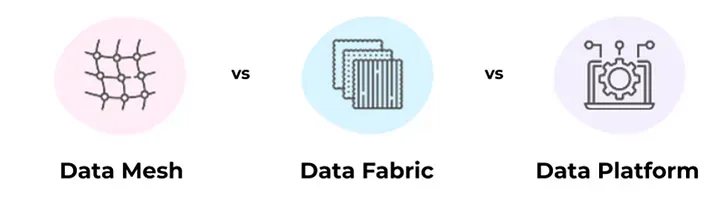
Data-first companies are using a resourceful data infrastructure to identify customer needs and grow productivity. With increasing volumes of data and complexity, organizations require architectural patterns that make data management more effective for your business.
With so many terms used interchangeably — Data Mesh, Data Fabric, Data Platform — it’s easy to misinterpret them and the conceptual understanding of these can get diluted. So let’s understand these concepts better.
This blog post highlights the nuances of these data engineering/ architecture terminology used commonly.
Data Mesh
Data Mesh is a buzzword coined by Zhamak Dehghani, transforming the modern data architecture model. It scales the data architecture through two primary ways, i.e., fundamental technology adaptation and organizational transformation. It puts data at the operational level as per the evolving data demands within an enterprise.
Data Mesh acquires its properties from data marts, data-driven design (DDD), microservices, and event streaming.
Zhamak coined the 4 principles that define a Data Mesh.
01. Domain-Specific Ownership of Data
Conceptually, Data Mesh to data architecture is often considered what microservices to Software development is. So, it breaks down the data into domain-specific packages. It provides decentralized access to data and eliminates the existence of any centralized roles and authentication.
02. Data-as-a-Product
Publishers publishing data must optimize data as a product, for which they need to sustain and meet the quality and usability standards.
03. Self-Service Design
Data Mesh allows you to extract data from multiple sources and integrate it into your database.
04. Governance
Data Mesh is standardized centrally and allows publishers and consumers to navigate data fast and easily. The architecture helps to turn messy architecture into a more uniform and manageable format.
Data Fabric
Whenever customers reach out to an insurance company with a claim request, the representatives run after sourcing different types of data to analyze the authenticity and eligibility of the applicants. It may take more time and effort to feed the right data as your data is stored in different silos, such as data warehouses, data lakes, and cloud.
So, how do we make this process more time-efficient and effortless?
Putting data in one place is not the solution as it may create more data governance and management issues.
Data fabric architecture connects data available across silos, sustaining compliance, governance, security, and privacy needs. Data Fabric connects data existed in all silos to optimize most of it stored in the organizational system.
While a data fabric governs and manages multiple data sources from a single, virtual centralized system, a data mesh follows the opposite approach. A data mesh creates multiple domain-specific systems, each specialized according to its functions and uses, thus bringing data closer to consumers.
In a data fabric, all the data is brought into a centralized location. Whereas in a data mesh, it is decentralized. Here, each of the data sets is treated like a product that is kept within each of the various organizations within a company.
Data Platform
Now, where does a data platform fit in all of this?
A data platform is a curated set of tools & technologies that collectively meets an organization’s end-to-end data management needs — across ingestion, storage, preparation, delivery, and governance of your data, as well as a security layer for users and applications.
A data platform combines a package of layers contributing to effective data management within enterprises.
From data ingestion to data consolidation and ETL, data platforms tend to counter a variety of data management-related challenges across silos.
Choose what suits the nature of your business.
The difference is that a data platform is a constant for all enterprises. It Whereas data mesh and data fabric are different architectural approaches for facilitating data movement.
The above-discussed data architecture models have been designed to meet unique business demands. For any enterprise, it is important to identify the factors that they should consider for choosing a data architecture model. Moreover, it should also ensure a smooth deployment.
There are 7 important parameters that you must consider while picking a data architecture approach for your business.
1. Usability
Your data architecture model should ensure extensive sustainability of data extracted from different teams.
2. Visualization & Reporting
How easily you can visualize the data extracted as a result of your queries is another crucial parameter for picking a data architecture model.
3. Security
Your business-sensitive data and information require a resourceful and flexible architecture, addressing and devoiding both physical and virtual risks.
4. Functionality
From automation, insight and analysis, and visualization to campaign planning and ROI management, your data architecture model needs to be compatible with your business requirements.
7. Scalability
Businesses require a data architecture model that can flexibly update and manage growing amounts of data.
Summary
While the interpretation of a data fabric compared to a data mesh has multiple variations, what is correct or is the best solution is based on your company’s data scale, security policies, and budgetary constraints.
Data fabric is defined as a technological concept, whereas data mesh focuses on improving the organizational structure of data. Data mesh entails concepts related to data management in a decentralized and large-scale manner. The former uses a centralized repository, unlike data mesh using a decentralized architecture
Alongside this, data companies provide a collective structure of multiple data management resources through data platforms.
Keep watching this space for more such perspectives.
Connect with us to learn how we help modern financial enterprises democratize data, leverage it, and drive profitability.