

Amazon SageMaker Unified Studio 2024: Key Updates, New Features, and Why It’s Better
Amazon Web Services (AWS) has taken Amazon SageMaker to the next level with the 2024 update, transforming it into a comprehensive platform for data, analytics, and AI. The new Amazon SageMaker Unified Studio simplifies workflows, unifies tools, and accelerates development for both traditional ML projects and cutting-edge generative AI applications.
Amazon Web Services (AWS) has taken Amazon SageMaker to the next level with the 2024 update, transforming it into a comprehensive platform for data, analytics, and AI. The new Amazon SageMaker Unified Studio simplifies workflows, unifies tools, and accelerates development for both traditional ML projects and cutting-edge generative AI applications.
In this blog, we’ll cover three major points, which are:
- The major updates introduced in SageMaker Unified Studio (2024).
- How it’s different and better than the previous versions.
- Why do these updates matter for enterprises and data practitioners.
What’s New in SageMaker Unified Studio (2024)?
1. A Unified Environment for Data, Analytics, and AI
The biggest enhancement is the unification of tools into a single platform. Previously, data preparation, SQL analytics, model training, and AI development were fragmented across various AWS services.
Integrated Tools:
- Amazon EMR: For big data processing.
- AWS Glue: For data preparation and ETL pipelines.
- Amazon Redshift: For advanced SQL-based analytics.
- Amazon Bedrock: For building generative AI solutions
These services are now seamlessly accessible through SageMaker Unified Studio, providing an end-to-end data-to-AI workflow.
Impact:
No more context-switching between tools. Data engineers, analysts, and ML developers can work together in a single workspace.
2. Amazon SageMaker Lakehouse: Open Data Access
- Amazon SageMaker Lakehouse: Open Data Access
The SageMaker Lakehouse introduces a flexible data architecture that unifies access to structured and unstructured data.
Centralized Data Sources: Access data stored in:
- Amazon S3 (Data Lakes)
- Amazon Redshift (Data Warehouses)
- Third-party or federated data sources
Why It’s Important:
This eliminates data silos, allowing seamless integration and transformation of data for ML and analytics.
Impact:
Organizations can manage and use their data efficiently for model training and analytics, enhancing productivity.
4. Generative AI with Amazon Bedrock IDE
- Generative AI with Amazon Bedrock IDE
AWS has integrated the Amazon Bedrock Integrated Development Environment (formerly Bedrock Studio) into SageMaker Unified Studio:
Build Generative AI Applications:
Quickly develop, customize, and deploy generative AI applications powered by foundational models from Amazon Bedrock.
Seamless Workflow:
Users can fine-tune models, generate embeddings, and deploy them without leaving SageMaker Unified Studio.
Impact:
Brings generative AI development into the same workflow as traditional machine learning.
- Amazon Q Developer Integration
AWS introduces Amazon Q Developer, a generative AI assistant, into SageMaker Unified Studio.
AWS introduces Amazon Q Developer, a generative AI assistant, into SageMaker Unified Studio.
Key Features:
- Data discovery
- Code generation
- SQL generation
- Troubleshooting workflows
It acts as an AI co-pilot, streamlining coding, data exploration, and model experimentation.
Impact:
Accelerates development by automating repetitive tasks, boosting productivity for developers.
Key Differences from Previous Versions
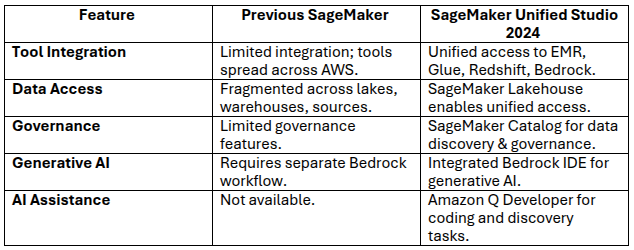
The 2024 updates introduce transformative changes compared to the older versions of Amazon SageMaker:
Why Do These Updates Matter?
- Unified Platform Saves Time: Data teams, ML engineers, and developers no longer need to juggle between multiple tools. The unified studio centralizes all workflows.
- Better Collaboration Across Teams:With governance tools like SageMaker Catalog, teams can securely collaborate on ML and data workflows, enhancing productivity.
- Generative AI Becomes Easier:By integrating Amazon Bedrock, AWS is bringing generative AI development into the mainstream. Teams can fine-tune foundational models and deploy solutions quickly.
- Open Data Access:The Lakehouse architecture makes it easy to analyze and model data from multiple sources without moving or duplicating it.
- AI-Driven Development with Amazon Q: Amazon Q Developer makes ML development faster by automating tasks like data exploration and SQL generation.
Conclusion
The 2024 updates to Amazon SageMaker Unified Studio mark a significant leap forward. By unifying data, analytics, and AI into a single platform, AWS is addressing the challenges of fragmented tools, data silos, and governance gaps.
With integrated tools for generative AI development, open data access, and enhanced governance, Amazon SageMaker Unified Studio is well-positioned as the center of modern data and AI development.
If you’re ready to explore the new features, head over to AWS SageMaker Studio and start building your next AI solution today!
For more updates related to AWS SageMaker Studio, contact our team.