

A Practical Guide to RAG for Business Leaders
In the previous blog, Retrieval-Augmented Generation (RAG) was discussed with a focus on how it can transform business operations, simplifying the concept for professionals who may not be immersed in the technical side of AI. We explored how RAG combines the strengths of information retrieval and natural language generation. The aim was to shed light on the strategic benefits of this technology for non-technical stakeholders.
However, in this blog, we will take a deeper dive into the technical mechanics of RAG, particularly focusing on how it can be implemented using the AWS Cloud. AWS offers a robust and scalable infrastructure, making it an ideal platform for deploying complex AI solutions like RAG.
Deep Dive into RAG
Retrieval-augmented generation (RAG) represents a significant advancement in the field of artificial intelligence by blending two transformative technologies: information retrieval (IR) and natural language generation (NLG). This synergy offers an approach that is both intelligent and adaptive, making it highly relevant across various sectors.
At its core, RAG enables machines not only to fetch the most appropriate information but also to craft detailed, human-like responses. This unique combination of retrieval and generation creates a more comprehensive and context-aware experience for your end users, enhancing how they interact with data in ways that were previously unimaginable.
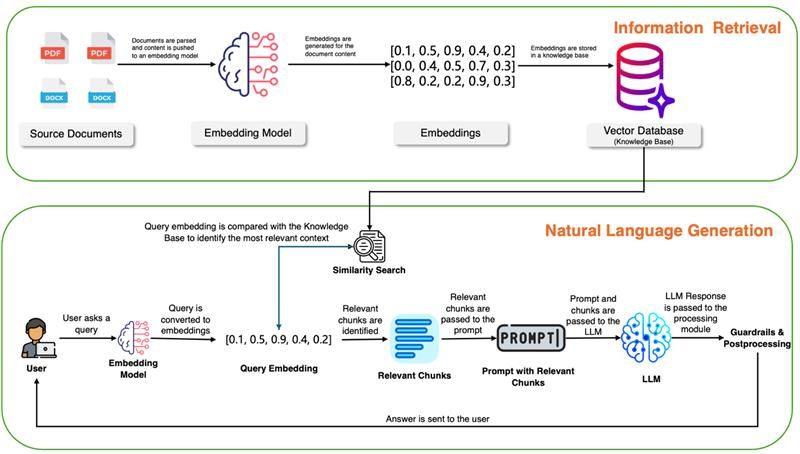
Information Retrieval (IR), often referred to as the quest for relevance, is the first foundational element of RAG. It begins by converting documents—such as PDFs or Word files—into numerical representations called embeddings. These embeddings are the AI's way of understanding and storing the essence and meaning of the content, which is then housed in a highly efficient vector database, known as the knowledge base. When a user submits a query, it too is transformed into an embedding, enabling the system to perform a similarity search across the knowledge base.
This sophisticated process helps pinpoint the most relevant sections of data that align with the user's inquiry. For businesses, this capability is invaluable, especially when dealing with industry-specific terminologies and nuances that require precision and depth of understanding.
The second element of RAG, Natural Language Generation (NLG), can be seen as the art of articulation. After the IR system has retrieved the relevant information, the NLG component synthesizes this raw data into a coherent and comprehensive response. By integrating the retrieved data with the user's initial query, a detailed prompt is passed to a powerful large language model (LLM).
This LLM transforms the prompt into a well-structured, contextually aware answer, carefully mirroring the tone and style of human communication. Beyond merely generating text, this step involves a sophisticated process of post-processing and filtering to ensure that the response is not only relevant but also polished, insightful, and free from potential inaccuracies.
The true power of RAG lies in its harmonious combination of retrieval and generation. While IR ensures that only the most pertinent information is selected from vast volumes of data, NLG ensures that this information is delivered in a natural, articulate, and user-friendly manner.
This creates a seamless user experience where queries are met with answers that are both accurate and enriched with contextual understanding. For organizations, this translates into enhanced decision-making processes, as stakeholders can access more precise and actionable insights, whether in the form of market analysis, product development insights, or customer service solutions.
As businesses and industries continue to generate massive amounts of data, the demand for intelligent systems that can both retrieve and generate meaningful responses has never been higher. RAG’s ability to handle both structured and unstructured data sets it apart, offering a solution that is not just reactive but highly proactive in addressing complex queries.
Technical Flow
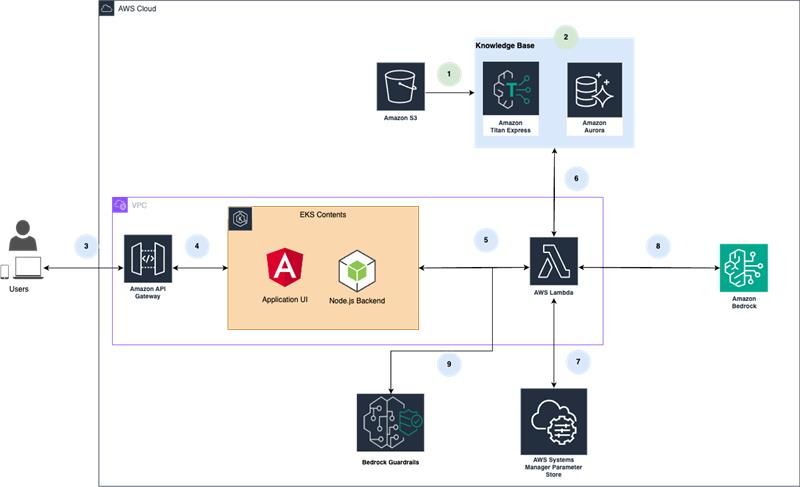
- Document artifacts (PDFs, DOCs, Excels, etc.) are placed in S3. These documents are the reference material for the chatbot service.
- The content of these documents are parsed, and embeddings are generated using Amazon’s proprietary Titan Express Model. These embeddings are stored in Amazon Aurora PostgreSQL.
- Users access the chatbot application through various devices (laptops, tablets, phones), and send in a query. Amazon API Gateway serves as the intermediary that handles API requests from the user's devices, routing them appropriately to the backend.
- The API Gateway routes user requests to the Amazon EKS, which hosts both the Application UI (built in Angular) and the Node.js backend. It can handle multiple requests and scale vertically.
- It processes user requests and passes them to an Amazon Lambda function. The Lambda function interacts with various AWS services and performs a lot of functions.
- The Lambda function uses Amazon Titan Express to convert the user query to embeddings, compares it to the knowledge base (Amazon Aurora) and retrieves the most relevant portions of the contents of the documents within S3.
- The Lambda function attaches this relevant portion or chunk to the prompt. The prompt is, first, retrieved from the AWS Systems Manager Parameter Store.
- The prompt with the relevant context is pushed to Amazon Bedrock, which generates human-like responses to the user's query using a pre-trained foundation model (LLM).
- Bedrock Guardrails ensures that the responses generated by the Bedrock model are aligned with the safety, ethical standards, and business rules. This step could involve filtering, validating, or post-processing the generated answers to prevent harmful or incorrect responses.
- After the relevant context is retrieved, response is generated, validated, and checked against guardrails, it is sent back to the Node.js Backend and eventually returned to the user via the Amazon API Gateway.
Conclusion
As businesses and industries continue to generate massive amounts of data, the demand for intelligent systems that can both retrieve and generate meaningful responses has never been higher.
RAG’s ability to handle both structured and unstructured data sets it apart, offering a solution that is not just reactive but highly proactive in addressing complex queries. With the integration of advanced technologies like vector databases and large language models, RAG is redefining how we approach information retrieval and communication in the digital age, making it an essential tool for organizations aiming to stay ahead in an increasingly data-driven world.
In the next set of blogs, we will explore strategies to minimize the risk of hallucinations by optimizing LLMs workflows, establishing testing and monitoring frameworks, and improving system transparency.
Discover smarter data solutions with LUMIQ’s RAG expertise.